Student: “Hey Mr. Ruff, do you know a _______ Ruff?” Me: “Uhh… Yeah…” Student: “Hehehehe… That’s his brother.” (10 minutes later) Student: “Hey Mr. Ruff, do you still live on __________ Drive?” Me: “Can we please get back to work on our geometry?”
Look kids, I get it. You’re growing up in an era where you have a massive amount of information at your finger tips.
I decided to leave the title and text above exactly intact as I had originally written on April 27, 2018. I’ve had some difficulty coming back to this because my little brother passed away four days later due to sudden heart failure. It’s now four years later and I’m still trying to reassemble the pieces of my broken heart. My therapist warned me that I couldn’t write my way out of depression, but it feels important for me to finish what I started here.
I’m not even sure where I was going with this in the first place. I think I just wanted to vent about the incident but couldn’t figure out how to do so without doxxing anyone. It’s not like I didn’t know this information was out there. I couldn’t be angry at this student for looking me up in publicly available records, but I also couldn’t help feeling vulnerable either.
The reality is that my digital footprint is massive. I’ve had a presence on the Internet since I was a teenager and you can still find some of that content if you know where to look. Some of that content is downright awesome! You’ll find teenage me engaging in philosophical discussions on artificial intelligence and building interactive websites. At the same time, there’s little doubt in my mind that you’ll also find me saying naïve or prejudiced things that I’m most certainly NOT proud of. This is the double-edged sword of participating in open forums.
There was much less risk of exposure when I was young and anonymous. Now that my digital footprints can be traced back to my real identity, there’s a strong sense of fear and anxiety that looms behind every word. Who is going to see this? How will they judge me for it?
Having quit my teaching job at the end of the 2020-2021 school year, my concerns about this have somewhat shifted towards “employability”. When I read this tweet from The National Cybersecurity Alliance saying that “70% of job recruiters rejected candidates based on information they found online”, I can’t help but wonder if that’s actively happening to me. If so, how would I even know?
I’m not the type of person to put up a façade. I will speak my mind to a fault. I call bullshit when I see it and try to own up to my mistakes. I’m proud of who I am. I fight fiercely for what I think is right.
The truth is that these very same qualities that I view as my strengths could be easily be flagged as “risks” by potential employers. I’ve made my peace with the fact that I’m a threat to any organization that’s not conducting its business ethically. There’s solace in knowing that those aren’t the types of the company I’d work for anyway, but I only have this choice because I come from a position of privilege to start with.
We’re entering a “damned if you do, damned if you don’t” era in social media. Having no online presence at all looks suspicious, but oversharing is also a considerable liability. People need to be held accountable for what they say online, but a moment of being human captured on the Internet shouldn’t permanently disqualify one from earning a living wage.
It’s not unreasonable for an employer to conduct research on prospective employees, but there is a strong need for for transparency in how that data is collected and used. The United States is in desperate need of privacy regulations in human resources. If something in my digital footprint is used against me in the hiring process, I should have the right to know what and how.
Lately I’ve been paralyzed by fear whenever I post something online. When you’re uncertain how your words will be interpreted, it’s quite easy to file it away under drafts but the silence is not sustainable. I need that sense of community now more than ever.
I’m going to try to start writing again and more frequently. Even if it scares me. Even if it feels forced. I can’t help if a potential employer stumbles across my digital footsteps, but I can assert control over the direction those steps are taking. Blogging can only work as a tool for self-growth if I accept the risks of making a mistake in public and write anyway.
[The following is a work of fiction, but it doesn’t have to be.]
8:07 AM: I pull into the high school parking lot. As part of Group E, my badge won’t even allow me into the building until 8:15 because everyone has staggered start times to prevent overcrowding the hallways. I do some light stretching and practice Tai Chi in the parking lot while I wait. It helps me focus up for the day.
8:20 AM: I breathe in the aroma from my fresh cup of coffee before setting it down on my desk, putting on my mask, and picking up my tablet. My desk is right near the door, as I’m always the last person in and first person out. I still have a couple minutes before students arrive, so I catch up the school’s internal social media network while I wait. The Science Teacher on my team has recently started blogging, so I read her latest post and leave some supportive words in the comments.
8:25 AM: My class of 8 students are starting to line up outside the classroom, in an order now habit based on seating, and I greet each of them at the door. On the first day I told them that I’m not exactly comfortable with handshakes yet, so they have their choice of a Young Frankenstein elbow bump or an eastern bow. They all know I’m a total weeb so the bow is surprisingly popular. As I take attendance on my tablet, it gives me a reminder that it’s Tim’s birthday. I wish him a happy birthday and let him know that all his teachers signed a card for him which he’ll find on his desk.
8:32 AM: The students watch a pre-recorded video from the principal on the large monitor at the front of the classroom containing the days announcements. Meanwhile, I sit down at my desktop PC and start checking in students from the Zoom waiting room. As I say hello and log their attendance, one my of two monitors provides me with “just in time data” on the student I’m talking to. I congratulate Sue on her team’s Rocket League victory and give Kay some encouragement for their upcoming Debate.
8:45 AM: Class has officially started, but it’s not really “mine”. The English Teacher’s lesson is broadcast live into my classroom from the one down the hall. My class is actually one of 8 classrooms that constitute a single cohort. All 8 teachers and 64 in-person students in the cohort share a common start time, common classes, common lunch time, and common departure time. These groups were established through data clustering algorithms designed to group students with common needs while also promoting classroom diversity. While the English Teacher’s lesson is running, I monitor backchannels like the chat room and answer homework questions on the discussion board. We have another 64 students in the course who are still fully virtual, but only about half of the online students sign in for synchronous activities and the rest are self-paced do to various circumstances.
9:10 AM: The English lesson is wrapping up and the Teacher outlines the details of the group activity to come next. We try to include have a five minute stretch break every half hour where students can stand up and break from the monotony of extended computer time. The kids also appreciate time to socialize freely amongst themselves.
9:15 AM: A deep “a-hem” grabs the attention of my students, and I begin facilitating the small group activity. We’re reading Concrete Rose as a class (and by “we” that includes myself) so we have some heavy conversations about systemic racism and its relation to gang violence ahead of us. Fortunately, I’ve been well prepared for these through substantial planning with my team. It’s still a strange feeling to be a “Math Teacher” in this kind of situation, but it gives me a chance to see students how develop students develop their arguments in a way I wouldn’t ordinarily see in my content area. I’m learning as much from the experience as they are and scribble down notes on how I can build deeper connections into my next stats lesson.
9:40 AM: Following the small group session, we take some time for each class to “share in” to the rest of the cohort. It’s always surprising to see how each “class” approaches the topic from a slightly different angle. After the English Teacher summarizes some key themes from these discussion, the Social Studies Teacher chimes in with a follow-up question relating our reading to the Black Lives Matter movement. This clues in the students to what learning experiences await them after their break. Their Social Studies time follows a similar pattern as the English class, with about half an hour of teacher-to-cohort livestream followed by a half hour of small group activities.
10:45 AM: Our cohort’s “lunch hour” begins — or at least that’s what we’ve taken to calling it. It really more of a combined lunch and study hall period which makes it easier to follow social distancing guidelines by staggering our trips to the cafeteria. My class won’t actually “go to lunch” for a while still, so I spend the time helping students catch up on missing assignments or help out with upcoming projects. Our class DJ throws on some hip-hop instrumentals which helps lighten the mood. Some of students can’t really restrain from singing along but the masks muffle out most of the sound so you can’t make out the words unless you know the jam in the first place.
11:03 AM: The persistent cranking sound of the automatic hand sanitizer dispenser fills the hallway as my students and I prepare to make our way to the cafeteria. We pick up our meal and immediately return to class to eat. Our actual lunch time is strangely peaceful. It’s one of the only times in the day where we’re not wearing masks but no one is really talking because we’re too hungry. A soft burp and whispered “excuse me” break the silence and gives way to laughter.
11:31 AM: Most students have finished eating by now but our lunch hour isn’t quite over. We still have some time in the schedule for students to wash their hands, use the restroom, and wrap up what they were doing during study hall. Meanwhile I take some time to prep the browser tabs I’ll want to have open for my upcoming presentation.
11:45 AM: I take a deep breath. Even after a year of teaching online in Zoom the camera still makes me a little anxious, but once I start talking about math I soon find my groove again. My lesson is simulcast from my desktop to the monitor at the front of my class, the seven other classrooms on the hall, and to about 40 students who are learning remotely. All 100+ students have joined me in a Desmos Activity, so as I’m talking to them about means and standard deviations they can manipulate the graphs in real-time. Continuing with the themes established by the English and Social Studies lessons earlier, we’re examining crime data before and after the implementation of three strikes policies. While I’m providing whole-cohort instruction, some of my co-teachers are providing live feedback through Desmos while others are direct messaging me with observations or student questions.
12:15 PM: We come back from another stretch break into small group instruction. Each of the teachers in my cohort has chosen a data set from a pool based on their interests. We’ve found that when we’re more engaged in the data as teachers that students get more into it as well. There’s a distinct math component of the task students requiring students to find the mean and standard deviation, but not all the data sets are normally distributed. Each class has to put analysis in context and decide whether or not this is the right tool for a job and what external factors might be influencing those numbers. I play the role of moderator as each teacher’s class reports back in.
12:45 PM: The final lesson of the day is led by our cohort’s Art Teacher. The theme of today’s lesson is “juxtaposition” and we review several examples from a variety of media. I can feel the excitement growing in the room as students start brainstorming what kind of symbols to use in their upcoming assignment.
1:45 PM: The students finish up their artistic compositions a while ago, and they’re now busy sharing their creations on the school’s social network. This time is technically a 15 minute break period for the students, who are presently taking turns using the restroom and refilling their water bottles. I take advantage of the opportunity to send my wife a text and see how her day is going.
2:00 PM: A line of school buses forms outside the main entrance, but my cohort won’t be actually dismissed for another hour since we were one of the later groups to arrive. The students use this time to complete their “homework”, which now seems like a misnomer since it all gets done at school. They have short reading assignments, reflection prompts from their English, Social Studies and Art Teachers, and couple math problems from myself. Each teacher keeps an open breakout room in Zoom during this time, so students can hop in and out as needed for additional help.
2:55 PM: The students have officially been dismissed for the day and I take a few minutes to collect myself before meeting with my fellow cohort teachers to plan tomorrow’s lesson. Most of the planning has already taken place asynchronously throughout the day by the Civics, Biology, Spanish and Computer Science Teachers, so they present the tentative plan over Zoom and solicit input from the rest of the team. In addition to the 8 “Core Teachers”, our team is supplemented by a group of 4 “Specialists” who help ensure that we’re meeting the needs of all our students. These specialists include a Behavioral Psychologist, a Social Worker, an Instructional Designer, and a Data Analyst, but all of them have been through considerable training on how to meet the needs of students with disabilities. They also help manage our students that are still fully virtual throughout the day and double as substitutes in the event any of the Core Teachers are absent. The system is designed this way to keep contract tracing as simple as possible.
3:47 PM: Our planning meeting wraps up a little early, so I take some time to catch up on the school’s social network again. I post a brief reflection from this morning’s discussion on my school blog and grade a few assignments in my queue.
4:06 PM: My work day was technically over at 4:00, but I got a little carried away responding to feedback on my blog post and lost track of time. I start packing my things to leave for the day. Per school policy, my cohort needs to leave by 4:15 PM so that the disinfecting team can be brought in to deep clean the classrooms. All of my work supplies stay at work and I walk out the door with a clear conscience regarding tomorrow’s instructional plan. I won’t have to even think about work until the following day.
When I joined Twitter back in 2009, I settled in on the following profile for myself: “I’m a video game developer turned educator, and hope to combine the two to make learning math FUN for people of all ages.”
At the time this seemed an appropriate description of myself, but I’ve been teaching for over a decade now and it seemed like time to update it. Many of the notions I had about teaching coming into the profession have since changed, as well as my very my sense of self-identity. I wanted a new Twitter bio to make a statement that would capture as much about my present day self as I could possibly fit in the 160 character limit. Here’s what I’ve settled on (for now):
I think this is the first time I’ve publicly called myself a “mathematician”. I’ve always been too nervous to do so when I only have B.S. and not a Ph.D., but years of teaching has changed how I thought about this label. I want my students to feel comfortable calling themselves mathematicians. How could I possibly hope to communicate this when I was hesitant to do so myself?
I came to the conclusion that having a degree doesn’t make one a mathematician. Having mathematical thinking permeate every aspect of one’s being makes one a mathematician. Under that definition, this is most certainly is a label I would use to describe who I am. If unilaterally calling myself a mathematician helps to remove this stigma of not having a Ph.D. for others, than it’s about time I start doing so.
I started thinking about what other terms I wanted to normalize using and the rest of the bio just sort of fell into place. It’s kind of a liberating feeling to simultaneously challenge certain labels by expressing myself. If this is what it means to play “identity politics”, then not only am I going to play — but I’m going to play to win.
This one goes out to all the future mathematicians.
Back in March, I wrote an article entitled Choosing whiteness in which I reflected on ways in which a family myth of Native American ancestry influenced my early conceptions of race. Since then, I started doing research into this myth through Ancestry.com, including a DNA test. I can now say that have substantial evidence indicating that I am not, in fact, Native American. I sincerely apologize for any harm I may have caused by falsely identifying as such.
It turns out that my darker skinned ancestor likely had a hereditary condition called “hemochromatosis” — a genetic marker I share with them. A build up of iron caused by this condition causes the skin to take a bronze/gray color which would explain why this particular ancestor looks so different from the rest of the family in old photos. Photographic technology has a well established bias towards lighter skin. This is probably how the family myth came into being.
I can’t undo the harm I’ve caused by perpetuating this myth, but what I can do is share the truth as I now know it. I’ve cross-referenced my genealogy research with Native Land. What follows is the history of the lands stolen by my ancestors (to the best of my knowledge):
From here, my ancestors start to migrate to the southwest. They likely travelled south through lands of the Hopi, Pueblos, Western Apache, and Hohokam on their way towards the west coast. Eventually, they settle on land stolen from the Chumash, Tongva, and Kizh.
I don’t know what words to offer that would ever make up for the atrocities my ancestors were complicit in, but I hope that acknowledging these tribes and the lands that were taken from them is a step in the right direction.
This whole experience has challenged a lot of my preconceptions about the relationship between my DNA and “who I am”. I’m going to do what I can to continue unpacking my own baggage in the future.
Our school’s new LMS has a blog feature, so I figured it was time for me to write a blog post about blogging. An act of “metablogging”, as it were, to introduce the technology to some newly formed online learning communities.
Let’s start with the basics.
The word “blog” is short for “web-log” — which is itself a technojargon smash-up of “World Wide Web” and “Log File”. I think most of my readers are familiar enough with the Internet to know what it means to be on the “web”, but perhaps the “log” needs a bit of explaining. A “log file” is a incrementally written record of “events” over “time”. Programmers often use logs to track down bugs in our code. Perhaps that’s why blogging evokes such strong feelings for me.
As a blogger, I publish an incremental record of my ideas at specific points in time publicly on the Internet in order to track down the errors in my understanding of the world through collaboration with my Personal Learning Network.
It’s kind of like an open journal and I would be lying to you if I didn’t describe that process as “scary as fuck”.
And yes, I’m capable of “code-switching” as needed, but I’m also a person who believes that sometimes an expletive is necessary in order to communicate an idea. The very notion that “you can’t say that” is precisely why blogging is so scary in the first place! I’ve written numerous posts where I got to the end and just never clicked “Publish” because the thought of it going out was absolutely petrifying.
Blogging is the art of failing in public.
That vulnerability is why it’s so important to establish a Personal Learning Network (or PLN) — a group of people that share a common interest in collectively furthering their knowledge about a topic. Blogging only works when you have an audience that’s receptive to where you are in your own development and will support you on your quest to get to the next stage. You need a PLN that’s empathetic to what you’re going through, but will also call you out on your “bullshit” (I’m pretty sure that’s the technical term) when you inevitably spew it. You need people you trust to hold you accountable for your personal growth.
It’s strange to think that my personal blog has been around for over a decade now — back to when I was a “new online student”. I can see certain themes emerge through my writing (i.e. self-reference!). I like to write when I’m angry; it’s hardest when I’m sad. There are some key changes in my thinking due to major events in my personal life and other changes that occurred as my PLN evolved over time. Looking back, I feel an immense sense of gratitude to all the people I learned together with online. Day after day, they inspire me to fight to become a better version of myself.
My hope is that this blog post might inspire you to start a blog of your own and begin the search for your own PLN. I know from personal experience that joining the “blogosphere” can help make online learning a lot less lonely and a lot more productive. Writing a blog takes work, but it can also be an extremely rewarding creative outlet if you keep at it. I encourage you to give it a try!
[This blog-post was originally written as a sequence of Tweets, so please forgive me if comes off as awkwardly chunked.]
Last week, Stephen Colbert asked Bernie Sanders what could be done for Joe Biden to win over “Bernie Bros”. I can’t speak for anyone but myself, but the thought of a Biden candidacy scares the hell out of me. I hope you’ll listen to why & consider that it’s “Not Me Us”.
I believe that the 2020 Election is going to be all-out “Information Cyber-Warfare”. Trump is a Compulsive Liar whose only hope of winning reelection rests in convincing the public that Biden is even less trustworthy than he is. Don’t underestimate his ability to do so.
Biden’s whole campaign rests on the premise that “Trump is worse”, but the greatest threat to the Biden campaign is going to be old video footage of Biden himself arguing against the positions he now claims to support. Biden has a “primary source” problem.
Consider this example. On Sunday, The New York Times runs a story about Tara Reade. There’s a bit that’s a little… contradictory. Well, maybe it’s best to just read it yourself.
Given that this sounds a little extreme, I try do the responsible thing and go looking for additional sources. I find over a dozen different videos of Biden touching little girls in ways that I could only characterize as sexual assault.
In this clip, former Vice President Biden uses a candid moment to fondle the chest area of a little girl — in front of her entire family. Her visible discomfort is extremely obvious. pic.twitter.com/PXZx68KEGe
How am I supposed to argue that Trump’s “grab them by the pussy” comment is inappropriate while Biden stands accused of doing precisely that? Maybe Joe should start listening to himself. I believe Tara.
So when this Compulsive Liar starts accusing “Fake News” New York Time of covering up allegations of Biden sexually assaulting women, how am I supposed to argue otherwise against all this video evidence? The only weapon that works against liars is the truth.
If the Biden campaign really wants to beat Trump in November, the first result on a Google search for “Biden touching little girls” had damn well better be a formal apology, a personal commitment to engage in sexual misconduct awareness training, and a plan for accountability.
Instead of anything remotely resembling corrective action, the strategy appears to be an attempt to frame Tara Reade as Russian asset. I guess blaming Russia is the default response when Democrats have nothing else to go on.
I can’t talk about the DNC framing people as Russian assets without disclosing that I actively helped the Virginia Green Party get Dr. Jill Stein on the ballot in 2016. I ultimately voted for HRC (by a die roll) but can’t help notice the similarities in discourse.
The NLP and AI tech to do this is readily available, it’s just a matter of finding enough appropriate training data. What’s more likely? A huge data set of rational political discourse? Or a huge data set of aggressive Internet trolling? My guess would be the latter. Ya nyet Bot.
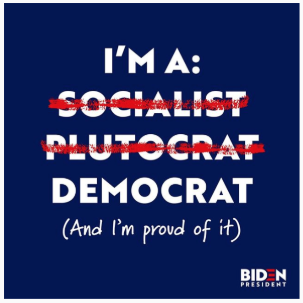
This real life Turing Test gets even more difficult when the Biden campaign is putting out troll bait campaign ads like this one. How do they expect to win over Sanders supports, many of whom identify as “socialists”, by lumping them in the same category as “plutocrats”?
Furthermore, this demonstrates a clear misunderstanding of what the word “socialist” even means. Without “socialist” institutions like the UNITED STATES POSTAL SERVICE, we can’t even have a “democratic” election during this pandemic. “Vote By Mail” is necessary to beat Trump.
Personally, I think the anti-Russia & anti-Socialist rhetoric is actually a disguise for anti-Atheism. It’s a relic of Cold War propaganda, just like how the phase “under God” was added to the Pledge. It explains why older and more religious voters leaned toward Biden.
This rigging arguement can potentially be dismantled by Biden campaign thru policy. By coming out in favor of approval voting, making election day a national holiday, and abolishing the electoral college, Biden could demonstrate solidarity with 3rd-party and independent voters.
Biden also demonstrates ageism with his proposal to lower the Medicare eligibility age to 60 and his continued support for ACA-like policies. Obamacare is essentially a tax on the youth that enables the healthcare system to continue profiting off the deaths of the old.
In response to COVID-19, Biden said he would “listen to the scientists” & “listen to the doctors”. Well Joe, I think the science is in and it says “Medicare for All” is NECESSARY to curb the devastation caused by pandemics like the one we’re presently facing.
.@JoeBiden says his number one concern during the COVID-19 crisis is "misinformation": "Listen to the scientists. Listen to the doctors."
If Bernie Sanders had been the nominee, we could point to his long history of supporting policies that would have minimized harm caused by the pandemic. The DNC sacrificed that argument by making Joe Biden the presumptive nominee on the basis of votes cast during the crisis.
There is ample evidence suggesting that our health care system is systematically disadvantaging Blacks, Indigenous and People of Color, who are literally dying of COVID-19 at disproportional rates due to man-made causes. Allowing this system to perpetuate itself is enabling systematic racism.
.@nhannahjones was ahead of the curve in warning us that #COVID19 was going to hit the Black community like a sledgehammer—which is why she started a Twitter thread to make them aware. Thank you for bringing us awareness through your work & social media. #OprahTalkspic.twitter.com/67YqRnZ3Gp
Biden’s campaign has an opportunity here to use “new evidence” from the outbreak as a justification for adding Medicare for All to his platform. In fact, he NEEDS TO if he wants to earn the trust of progressives. It’s a matter of life or death for some voters. Medicare for All Or Bust.
Likewise, I think it’s contradictory for Biden to say he’ll “listen to scientists” & not support an aggressive Green New Deal. The scientists are all saying that we need aggressive action NOW to preserve the continued habitability of our planet. There is No Planet B.
If I’m correct about the role disinformation will play in the 2020 election, this Compulsive Liar is going to double-down on every lie he’s ever told while simultaneously pointing out every inconsistency that Biden has ever engaged in. Complete with video evidence.
I’m not going to be able to argue that Biden didn’t do the things that he did. Instead, the only course of action left open to Biden is to openly acknowledge his own mistakes & run a campaign that depicts his ability to adapt to new information as a boon rather than a bane.
Come November, I plan to vote in such a way that I believe minimizes harm. However, it would be dangerous to presume that this necessarily dictates a vote for Joe Biden. I won’t say “Never Biden”, but there ARE reasons why I’m not a Democrat & it would be foolish to ignore them.
Don’t dare try to equate my involvement with the Green Party with support for Trump. You can’t use the “excluded middle” argument against a Compulsive Liar while Biden also has a tenuous relationship with the truth. His inconsistency makes me distrust him.
I’m not saying all this to help Trump & I don’t think anyone who read the whole thread could come to that conclusion. On the contrary, I’m saying all this precisely so that Joe Biden can understand what he’s up against & how to win the support of “socialists” like myself.
As one last point, I’d suggest that Joe Biden convincing Alexandria Ocasio-Cortez to be his VP would assuage many of my fears about a potential Biden administration as a former Bernie Sanders supporter. AOC4VP!
Today, @AOC pushed for Joe Biden to shift leftward on four key policy issues in order earn the trust of his party's progressive wing — federal treatment of Puerto Rico, immigration, health care and climate change https://t.co/c7tGOUBhtcpic.twitter.com/6ajhfXKH27
IBM Data Science Professional Certificate Capstone
Introduction
When I first connected to the Foursquare API, I did a test search around my current location (Portsmouth, VA) and found only a dismal selection of venues to look at. For my capstone project, I thought it might be interesting to see if I could use the Foursquare API to locate other Virginia cities with a similar Foursquare venue profile to found out what characteristics these cities share in common.
I think this information might be valuable to providers of APIs like Foursquare, because it would allow them to enact targeted plans to engage excluded communities and increase coverage of their app.
Data Sources
List of Virginia Cities from Wikipedia
Geolocation data scraped from Geonames.org
Foursquare API
Methodology
I started by web-scraping a table of Virginia cities from Wikipedia. Next, I used the list of Virginia cities to look up corresponding zipcodes and geographic coordinates from Geonames.org. Once I had compiled a list of cities and zipcodes, I used the Foursquare API to search for venues near each location. Next, I had to clean up the data to remove duplicates of venues that were within the search radius of more than one city.
I started with a high level analysis using only the “Foursquare venue density” of each city. I divided the density into quartiles to visualize the results. This revealed some obvious trends related to population density, so I decided to further break down the data using a k-means clustering algorithm using the venue categories.
Results
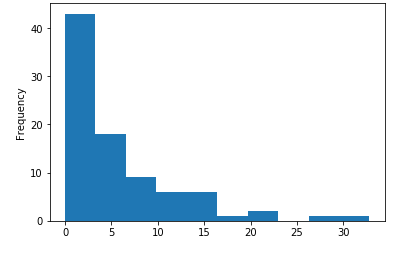
My initial cursory analysis looked only at the venue density near each city. Using a histogram of the venue density revealed that Portsmouth was actually had much higher venue density than I had originally thought (at 9.125 venues/zipcode). A significant number of Virginia cities had no Foursquare venues at all.
Number of cites by approximate Foursquare venue density
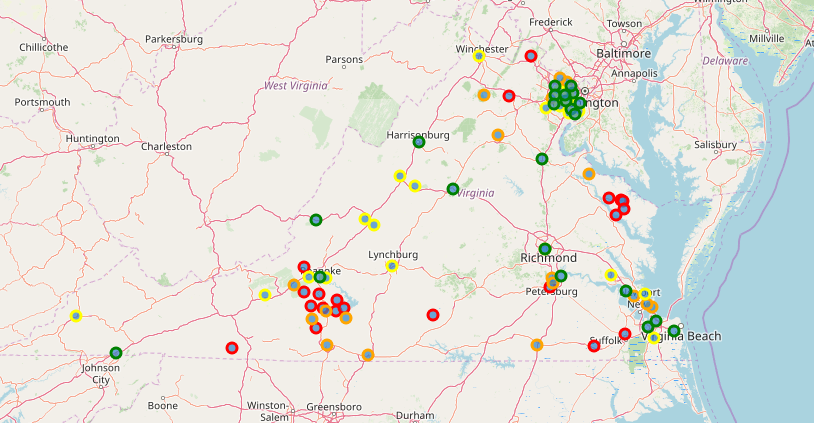
To get a rough idea of where these low and high density areas were, I color coded each city by quartile.
VA Cities by Foursquare Density Quartile
To get a better idea of what venues were present in each location, I used a kmeans clustering algorithm to identify cities with similar types of venues. These algorithm produced the following clusters:
Cluster #1 contained the cities of Chester Gap and Ferrum. This cluster scored high in venues identified by ‘Sandwich Place’ and ‘Trail’.
Cluster #2 contained the cities of Penhook, Greenway, Great Falls, West Mclean, and Culpeper. This cluster scored high in venues identified by ‘Garden Center’, ‘Home Service’, and ‘Park’.
Cluster #3 contained only the city of Fort Monroe and was identified based on ‘Beach’ venues.
Cluster #4 contained the majority of Virginia Cities. This includes: Marshall, Suffolk, Emporia, Elliston, Colonial Beach, Colonial Height, Martinsville, Vienna, Burke, Centreville, Hampton, Danville, Newport News, Virginia State University, Rocky Mount, Williamsburg, Reston, Poquoson, Mount Vernon, Vinton, Lorton, Lexington, Dunn Loring, Radford, Fairfax, Salem, Waynesboro, Norton, Buena Vista, Lynchburg, Staunton, Chesapeake, Annandale, Henrico, Winchester, Manassas, Fairfax Station, Virginia Beach, Roanoke, Covington, Portsmouth, Fredericksburg, Newington, Fort Eustis, Herndon, Chantilly, Hopewell, Springfield, Charlottesville, Bristol, Fort Belvoir, Falls Church, Richmond, Clifton, Norfolk, Alexandria, Harrisonburg, Mc Lean, and Merrifield. These cities were characterized by having a high diversity of Foursquare venue types.
Cluster #5 contained Virginia cities with no Foursquare venues at all. This includes: Wirtz, Warsaw, Franklin, Galax, Glade Hill, Haynesville, Henry, Village, Farnham, Oakton, Catawba, Callaway, Randolph, Redwood, Sharps, Boones Mill, Bent Mountain, Union Hall, Petersburg, and Waterford.
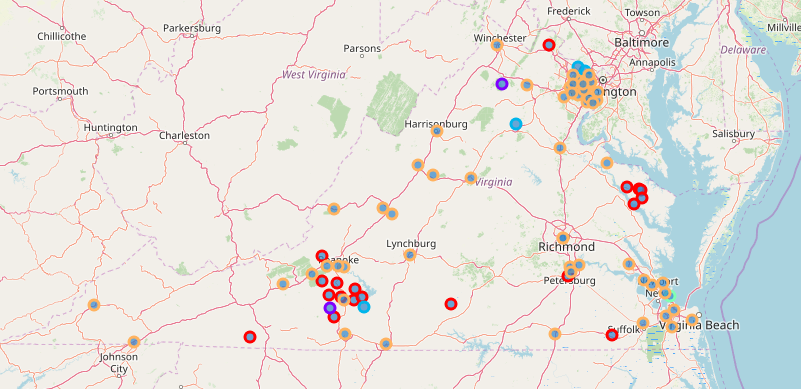
These clusters produced the following map:
Virginia Cities by Foursquare Venue Type Cluster
The source code used in this analysis can be found on GitHub:
This map showed several similarities with the venue density map, implying that the number of venues was a very strong factor in the clustering. Foursquare seems to have a very limited venue selection outside of major cities and urban areas.
The rural cities primarily had venues related to natural attractions (parks, trails and beaches). This pattern suggests that Foursquare might be able to improve its coverage of Virginia cities through advertising targeted at outdoor activities. Partnering with companies like REI or Bass Pro for incentives to increase the Foursquare user-base could potentially draw in users from under represented Virginia cities.
Conclusion
Overall, the results of this analysis were very much in line with what one would expect based on population. Cities with high populations had higher rates of Foursquare usage, and thus more venues to work with. Foursquare would need to make a substantial effort to draw in users from rural areas to increase coverage in Virginia. A more detailed analysis should try to control for factors like population and demographic information to rule these out as intermediate factors before attempting to identify patterns in venue types.
I want to tell you a story today about racism and mathematics.
Well, to be more specific, I’m going to make the argument that trends in mathematical notation can have culturally biased consequences that conferred systematic advantages to white people. I’m going to make this argument through a sequence of math problems, so I hope you’ll follow along and attempt them.
I don’t know if I’ll be able to “prove” this argument to you in the course of this activity, but hope this activity at least instills a sense of “doubt” in the idea that math is objectively neutral.
Without further ado, let’s get started.
Place a mark on the number line where you think “1 Thousand” should go.
Got it?
Okay, I’m going to make a guess as to where you placed it.
Ready?
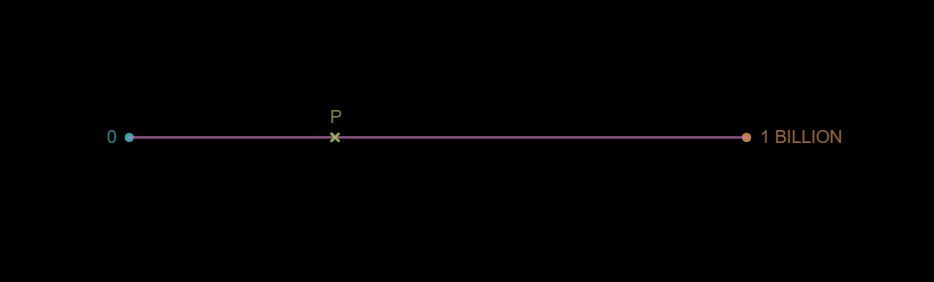
Did you place it at point P below?
Sorry, I hate to be the one to break it to you, but according to the ‘math powers that be’, this is technically incorrect. However, I want you to hold onto this idea because I’d argue that you’re not as wrong about this as they say you are.
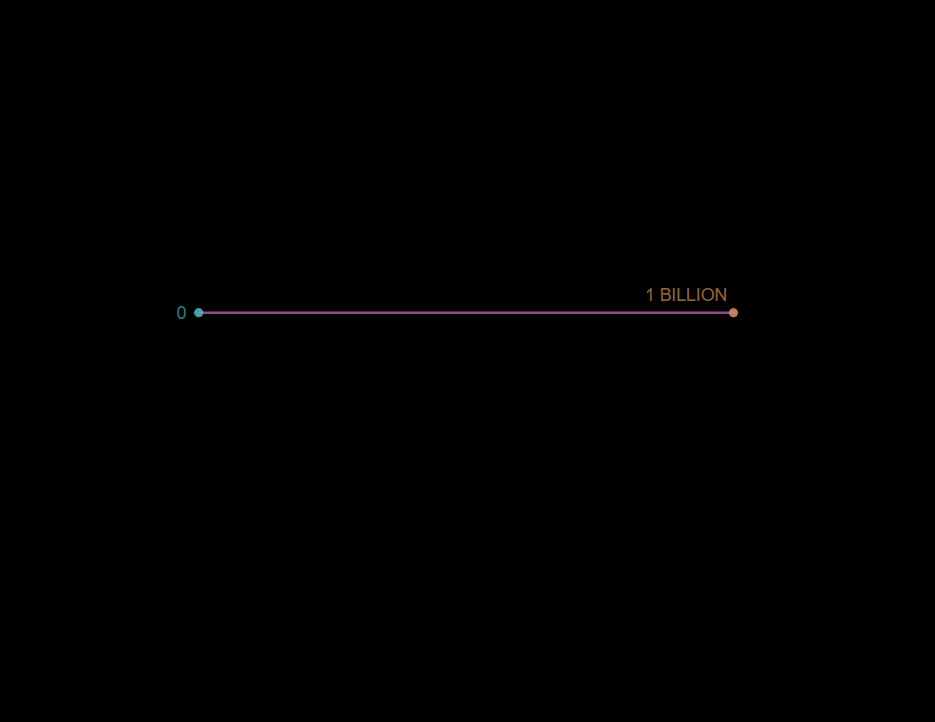
Here’s where you “should” have placed it.
When mathematicians present you with a graph, we implicitly assume that the graph is on a “linear scale”. That means that each unit is equally spaced along the line.
One billion divided by one thousand is one million, which means that “1 thousand” should be placed “1 millionth” of the way between 0 and 1 billion.
At the scale of this graph, this number is so close to the 0 that they’re visually indistinct.
So what about that other point?
That’s actually placed at the value 1/3*10^9 or “one third of a billion”.
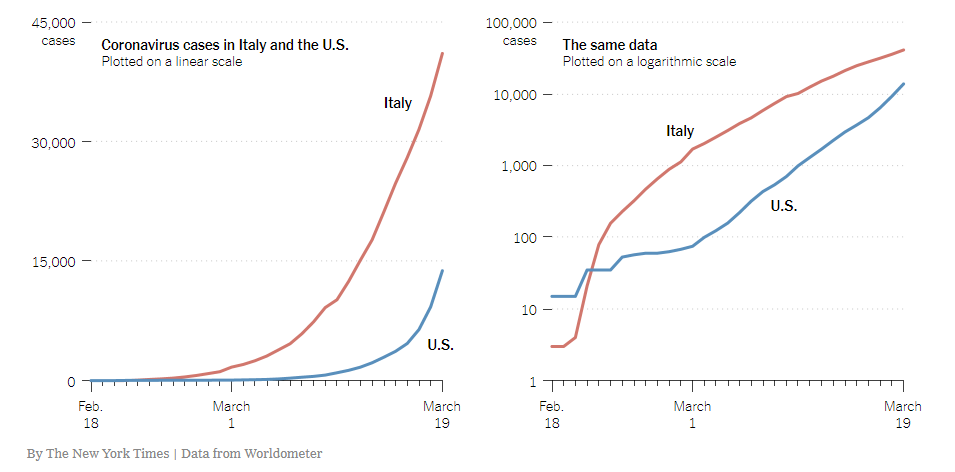
However, I don’t want you to think you’re wrong if you placed it here. In fact, this is the correct placement of 1000 on another type of scale.
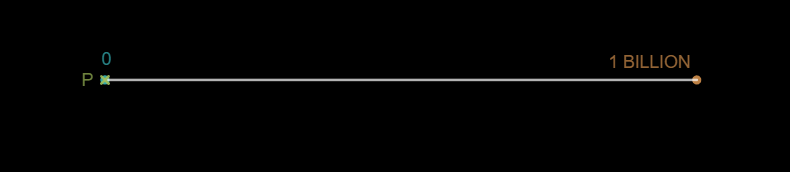
Check out the following scale instead:
So what would you call a scale like this?
Take a second and write it down.
Go ahead. I’ll wait.
According to the “mathematical community”, this is called a “logarithmic scale”.
Under a logarithmic scale, each successive “unit” gets multiplied by a common factor, such as 10, rather than adding. This results in a scale like in the diagram, only the “0” is actually 10^0 = 1.
There’s even research suggesting that human may actually be predisposed to think of numbers this way, and that the linear scale is a learned behavior. We see it in Indigenous cultures, in children, and even other species. Thinking “linearly” is a social norm that is distributed through cultural indoctrination. It’s like mathematical colonialism.
Here’s my problem with that diagram. If I hadn’t been taught to call this a “logarithmic scale”, I would have called it a “power scale” or an “exponential scale”. Doesn’t that name intuitively make more sense when you see this sequence of labels?
Before we go any further, let’s talk about mathematical notation.
What do you think makes for “good mathematical notation”?
What sort of patterns do you see in the ways that mathematicians name things the way they do?
Here’s what I perceive as the primary patterns in mathematical notation.
Mathematicians sometimes name things “descriptively”: the name tells you what the thing is. For example, the “triangle sum theorem” tells you implicitly that you’re going to add up three angles.
Mathematicians sometimes name things “attributively”: the name tells you who came up with the idea. For example, “Boolean Algebra” is named after “George Boole”.
Mathematicians sometimes name things “analogously”: using symbols with visual similarities to convey structural similarities. For example, “∧ is to ∨ as ∩ is to ∪”.
Mathematicians sometimes name things completely “arbitrarily” for historical reasons. Don’t even get me started on the “Pythagorean Theorem”…
Where would you classify “logarithm” in this scheme?
Personally, I think it depends on who you ask.
If you know a little Greek (which is a cultural bias in itself), you might argue that this label is “descriptive”. The word “logarithm” basically translates to “ratio-number”. The numbers in this sequence are arguably in “ratios” of 10, but does that actually convey enough information for you to know what logarithms really are?
I’d argue that this label is in fact “arbitrary” and actually refers to “how logarithms were used” rather than “what logarithms are”.
So what is a logarithm?
Generally speaking, we define a “logarithm” as the “inverse power function” or “inverse exponential function”.
Just as subtraction undoes addition, and division undoes multiplication, a logarithmundoes a power.
For example, 10^5 = 10000 so log10(10000) = 5.
Though a little clumsy, maybe this will make way more sense if we just used the following notation:
log10(10000) = power?10(10000) = 5
The natural inverse of “raising something to a power” would be “lowering it” it right? The mathematical statement, log10(10000) says this:
“What power of 10 will give you the number 10000?”
The answer to that question is 5. This is the essence of a logarithm.
So why don’t we just call logarithms “inverse exponents”?
Well, we call them “logarithms” because this was the term popularized by a guy named John Napier in the early 1600s.
Normally I’d be okay with the guy who created something getting to name it. However, I don’t think that honor should necessarily go to Napier. This idea of “inverse powers” had shown up in the early 800s thanks to an Indian mathematician named Virasena, and the way Napier employed logarithms was similar to an ancient Babylonian method devised even earlier than that.
What Napier did, in my opinion, was convince other white folx of the powerinherent in logarithms.
Please, allow me to demonstrate with some “simple” arithmetic. Try to do these two problems without a calculator.
Problem A: 25.2 * 32.7
Problem B: 1.401+1.515
Go head, take as much time as you need.
Which problem was harder?
Problem A, right?
Here’s the mathematical brilliance of the logarithm. It turns out that this “inverse power function” can be used to take a very difficult multiplication problem and turn it into a much simpler addition problem. Problems B can be used to provide a very reasonable approximation to Problem A in a fraction of the time if you look at it through the use of logarithms. They didn’t have computers back then, so they used tables of precalculated logarithms to drastically speed up the computation of large products.
Here’s how it works.
Start by looking up the logarithms of the numbers you want to multiply:
log(25.2) ≈ 1.401
log(32.7) ≈ 1.515
Once you’ve taken the logs, add them together.
1.401+1.515 = 2.916
Finally, do a reverse look up to find the number that would produce this logarithm.
log( ? ) = 2.916 = log( 824.1 )
This reverse look-up is really the power function: 10^2.916 ≈ 824.1.
Pretty neat?
The result 824.1 is pretty darn close to the actual value of 824.04. It’s not perfect because we rounded, but it’s reasonable enough for many applications.
This idea of using logarithms to speed up calculation resulted in the invention of the “slide rule”, a device which revolutionized the world of mathematics. Well, more accurately, it revolutionized European mathematics at approximately the same time that the British Empire just happened to start colonizing the globe.
Let’s spell that timeline out a little more explicitly:
~800 CE: Indian mathematician Virasena works on this idea of “inverse powers”.
~1600 CE: John Napier rebrands this idea as a ‘logarithm’.
~1700 CE: Invention of “slide rule” using logarithms to speed up calculations helps turn Europe into an economic powerhouse.
~1800 CE: The British Empire begins colonizing India.
Do you think this is a coincidence?
I don’t.
I think European mathematicians were quite aware of the power this tool provided them. Naming this tool a “logarithm” was a way of intentionally segregating mathematical literature to prevent other cultures from understanding what logarithms really are.
When a tool provides this much computational power, the people using that tool have a strong motivation to keep that power to themselves.
It’s like the recent linguistic shift in the usage of “literally” and “figuratively”. People have used the word “literally” to describe things “figuratively” in such large numbers that they have literally changed the meaning of the word.
Logarithms have been used to describe exponential behaviors for so long that the relationship between “powers” and “inverse powers” has become blurred by mathematical convention.
This has far reaching consequences for mathematics education where we need students to understand the implications of exponential growth. This is even more important considering the recent COVID-19 pandemic.
If I accidentally referred to the second graph as an “exponential scale” instead of “logarithmic scale”, would you still know what I was talking about?
What’s the point of calling it that?
I think we need to acknowledge that there exist “self-reinforcing power structures” in mathematics. These mathematical tools provide power to people, so those people fight to keep that power to themselves. This is an act of “segregation”.
After time, these tools become unavoidably common place. Now we’re in a situation where mathematicians argue that these norms should be “assimilated” because their use has become so widespread.
As a result, these cultural biases have resulted in a sort of mathematical colonialism that masquerades as objectivity. I believe that this ethnocentrism systematically disenfranchises BIPOC by hiding the true history of these mathematical ideas. This, in turn, results in systematic biases in test scores between whites and BIPOC, which then reinforce the original stereotypes.
It’s a vicious cycle of racism.
Wouldn’t you agree?
It might be too late to stop the use of the word “logarithm” in mathematics. It’s now something of a necessity to understand a wealth of other mathematical advances that have been built on top of this concept. However, that doesn’t mean we should pretend that this term is completely neutral either.
I hope you’ll leave here today with a better understanding of why it’s important to look critically at our mathematical conventions and acknowledge that math is not exempt from cultural biases.
It had been years since I’d been in a live chat on Twitter (I miss you #mathchat!), but I decided that this year I was going to participate in the #ClearTheAir Spring Semester. Live chats can be intimidating. It literally took me 30 minutes to tweet a response to the first question! I panicked when I saw that I was already 15 minutes late to the second question:
ACTUAL Q: What does it mean to choose Whiteness? In what ways did your family choose it? What do you think was lost? How does Whiteness impact your life? What do you notice about it now that you didn’t before? 2/ #ClearTheAir— ClearTheAirEdu (@ClearTheAirEdu) January 9, 2020
I hastily assembled a response that, looking back, is shallow and deflects from the real question. This tweet had triggered defense mechanisms I’m only recently coming to terms with. I didn’t perceive myself as choosing whiteness, and I’m only now realizing that the fact that I didn’t need to choose whiteness in order to reap its rewards is the very definition of white privilege.
When the chat returned to this topic the following week, a thread caught my attention with the following tweet:
I think I’m trying to figure out what “woman of color” means. @ClearTheAirEdu talked about closure. I want it. some definition when I’m between languages, between latinx countries, between Americanness, lighter on one side of the family and dark on the other, like the moon.— dulce-marie is still angry. (@DulceFlecha) January 16, 2020
Even now, this tweet conjures all sorts of emotions I’m not sure how to process. They seem to stem from a childhood memory, which I believe was from my 5th grade class. We were given an assignment to learn about our heritage and bring in a food that representative of that culture with the class.
I go home and tell my parents about the assignment. My dad identified himself as mostly German with a little bit of Swedish. My mom identified herself as mostly Yugoslavian with a little bit of Native American (Note: these statements are problematic on many levels, but this is about how I understood it at the time). I asked my mom if there was some kind of Yugoslavian food I could bring in. She pauses in thought for a moment, then says that it would be a lot of work and suggests that I bring something German instead. We head to the grocery store for a loaf of pumpernickel bread and some butter. It’s my first taste of “German food”, so I was kind of excited about it.
The day of our multicultural potluck, I present my story to the class and pass out my slices of pumpernickel. As I do so, I hear someone whispering something. I only make out one word, but that one word is enough to make me feel dizzy:
“Nazi“.
Did I really hear that? Did someone really say that? How could someone possibly come to that conclusion based on me being German? I tried as best as a kid could to put these thoughts out of my mind, but no 10 year old is really equipped to handle that level of guilt.
I think this is the origin for many of the defense mechanisms that would eventually develop into my own white fragility. I might even go so far as to say this was my childhood model for race in general. My dad’s side of the family was obviously “white”, but my mom’s side of the family was “less white”. What really drove this idea home was the fact that I started to see the difference within my own family.
My dad had three children from a previous marriage, and there were noticeable differences in skin tone between them and myself. They were “white”; I was “tan”. When they stayed out in the sun too long they turned “red”; when I stayed out in the sun too long I turned “brown”. My full-brother’s skin was like mine, so it was clearly linked through our mother. Even if my mom’s story about our Native American heritage was true, I knew that it was only a tiny amount. I didn’t even know how I’d begin to verify the story, but it explained an observable phenomena in my immediate family so I didn’t have any reason not to believe it.
I knew better than to try and identify myself as “Native American”, but it made me question where to drawn the line between “white” and “not white”. I came to the conclusion that the distinction was bogus and refused to make a choice at all. In reality, distancing myself from whiteness was just a defense mechanism to avoid a collection of painful memories.
When I think about “choosing whiteness”, I think I have to break it down specifically in the context of my family. Looking back, I chose to identify with my mom along multiple vectors. My mom and I were the left-handed liberals while my dad is a right-handed conservative. Since I associated my dad with both “white” and “male”, I thought perhaps it might be helpful for me to look at how I chose to incorporate the latter into my identity. I’m not sure of the exact moment, but know there was a distinct shift in my thinking about gender sometime in my teens.
Growing up, I rejected a lot of things that would be considered traditionally masculine. I spent more time playing with “My Little Pony” than “G.I. Joe”. I prefer musicals to football. However, I didn’t really distance myself from the word “male” the same way I did with the word “white”. I think this was made possible because I had strong feminist role models who taught me to look critically at gender. By “choosing male”, I accepted the fact that I was a male and that being one gave me privileges. Rather than distancing myself from the word “male”, I owned it. I acknowledged that “men” had a history of doing terrible things and that I would take it as a personal responsibility to challenge those statistics and disrupt the patriarchy however I could.
If “choosing white” were to be the analogue of this notion for race, I think the turning point for me reading Chris Emdin’s “For White Folks Who Teach in the Hood… and the Rest of Y’all Too”. By even purchasing this book, I had acknowledged that I was “white folk” and that I needed help understanding how to “teach in the hood”. In fact, this gives me an approximate date for “choosing whiteness”: November 14th, 2016. I think this his the first time I sincerely applied the label “white” to myself and acknowledged the social implications thereof.
Just reading wasn’t enough though, and what really drove this idea home for me was Emdin’s “homework”. He had challenged me to step out of my comfort zone to visit a Black barbershop and a Black church. Something about being the only white person in a “Black space” really puts one’s whiteness into perspective. The barbershop has become a routine occurrence now. I’m still processing the experience of visiting a Black church; I’ve never felt so simultaneously out of place and welcomed at the same time.
Coming to terms with what it meant to be white was only the beginning. Emdin also made me reassess significant aspects of my sense of self-identify by using the word “neoindigenous” to describe students. He had instilled this idea that the classroom didn’t belong to me, but my students. It forced me to take a hard look at what it really meant to be “Indigenous” and come to terms with the fact that I wasn’t.
Being Native American was never a matter of “blood” as I thought when I was young. It’s a matter of tribal membership, which I clearly do not meet the definition of. Even if my family story was true, I had long been socialized into the culture of the “Colonizers”. I have no right to call myself “Native American”. This concept that the relationship between Indigenous and colonialism was completely separate from “race” forced me come face-to-face with a very uncomfortable truths about my own heritage.
Even if my family story was true (and I have little evidence to back it up), it implies that my white ancestors traveled across the country during the western expansion. These white ancestors most likely came into contact with my supposed Native American ancestors somewhere around present day Idaho. Their decedents most likely traveled south through Utah and Arizona to end up in California, while gradually assimilating into white society.
Here’s the part that I struggle with. In order for this Native American ancestry to be true, it also implies that my white ancestors were complicit in the colonization and genocide of the Indigenous people. This is a heavy burden to bear, knowing that some of my ancestors may have committed one of the greatest atrocities in American history against the Indigenous people who may also be my ancestors. I feel like my very DNA is filled with violent contradictions. Maybe that’s what it really means to “choose whiteness”.
During the #ClearTheAir Zoom with Paul Gorski, he made a remark about “embracing whiteness” being akin to “self-hate”. I felt a little uncomfortable about the statement until I started digging into the language a little deeper. First, I wasn’t trying to “embrace” whiteness. I was just trying to “understand” it and “accept” it. Second, it helped me recognize that the feelings I carried towards whiteness weren’t characterized by “hate”. I felt guilt, and I felt shame, but not “hate”.
To “choose whiteness”, for me, was to accept the all the moral contradictions in the last 200 millennia of human history. Not only am I likely to be a decedent of murderers, rapists, colonizers, slavers, and thieves, but I am also likely a decedent of their victims. I will not let the crimes of my ancestors define me, but I will acknowledge that their actions have left me a heavy burden to carry. I will prove myself better than them by fighting to undo the damage they have caused because that’s the kind of human I want to be.
I hope this answer finally does justice to the question that prompted it.
It seems strange to think that so many of my misconceptions about race could be tied back to a single childhood memory, but maybe that’s how this process of socialization works. I think I now have an obligation to find out how much of my family story is really true. I promise to continue digging and see what else I discover about myself.
I’d like to thank the following people who have both challenged me and given me inspiration on this journey (in no particular order):
I have a confession I need to get off my chest. I think Geometry is racist. Well, not geometry (the discipline of mathematics), but specifically Geometry (the course commonly taught in American High Schools). I realize that in presenting this argument I’m going to have to make some rather sweeping generalizations about human history, but I that it’s important for me to put this hypothesis into words because I don’t think there’s enough evidence to disprove it.
Fair warning: this may be a lengthy read.
I believe that the reason the curriculum of Geometry specifically references Pythagoras, Euclid, and Descartes is because this emphasis provided Whites another means by which to rationalize slavery. Greek society was a prototype for White society because it used mathematics and philosophy to moralize slavery, and Descartes provided Whites a method of reconciling this position with Christianity.
To understand this, we first need to acknowledge that the entire human history of mathematics is intertwined with human slavery. Both mathematics and slavery emerged in early civilizations after the transition from hunter/gatherer to agricultural society lead to social stratification and the development of written language. In fact, I think mathematics is a necessary precondition for slavery. The very concept of slavery depends on a life being assigned a quantifiable value. Slave labor provided the ruling class with the time and resources to work on furthering mathematical knowledge, and then advances in mathematics were used to increase the efficiency of the slave trade. This vicious cycle quickly elevated the slavers to a god-king status which they then exploited to moralize their slavery.
Our oldest mathematical texts are from Egypt and Babylon, approximately 4000 years ago. Surviving records such as Plimpton 322, the Moscow Mathematical Papyrus, and the Rhind Mathematical Papyrus show that teachers have been giving math worksheets of roughly high school level difficulty since at least 1900 BC. What’s interesting about these three texts is that all three of them show evidence of the Pythagorean Theorem — over a thousand years before Pythagoras was even born! There’s also a strange lack of evidence attributing the theorem to Pythagoras, along with indications that proofs of it may have been circulating in Mesopotamia and India several hundred years prior. The very fact that this theorem bears the name of Pythagoras despite this questionable lack of evidence should alone be sufficient evidence of Geometry’s racism, but Pythagoras is only the first of three dominoes.
When Pythagoras supposedly lived around 500 BC, the Greeks (and Romans) had lively slave trades. However, unlike the god-king theocracies of Babylons and Egypt, the Greeks fashioned themselves as a “Democracy”. The Greeks needed an alternative means of moralizing slavery and whether he intended it or not, Pythagoras’ merger of mathematics and philosophy provided them with all the justification they needed. The Greeks used philosophy and mathematics to separate themselves from the people they enslaved, which served as a prototype for White society. Those that didn’t measure up to Greece’s intellectual standards were labeled as “barbarians” and treated as less than human. To paraphrase Plato, these barbarians were in the dark and needed to be shown the light. Incidentally, the “barbarian tribes” of Northern Europe enslaved by Greeks and Romans were likely a source of genetic markers for light skin, light hair and light eyes that would later be associated with “Whiteness”.
Meanwhile, mathematics probably continued to develop in the Middle East with influence from early civilizations in India and China. However, we don’t know by exactly how much. There’s another strange lack of mathematical records from Babylonian society under the Persian Empire. What we do know is that when Alexander the Great conquered the region in 331 BC, the Greeks assimilated a wealth of astronomical data. It’s quite likely that the Greeks stole whatever mathematical data they could through military conquests and these materials ended up in the Library of Alexandria where Euclid would have had access to them. Euclid’s work is based on a set of stolen mathematical literature that Euclid was privileged to have access to. While it’s impossible to discount the probability that Euclid might have added some original ideas, I do think this fact merits taking a closer look at his work and evaluating whether or not it belongs in our school’s curriculum.
My problem with the presentation of Euclid in Geometry (the course) is the parallel postulate. To be fair, presenting Euclid’s axioms as fundamental truths about the universe made sense in mathematics education up until as recently as 1905. We now know that space is not “flat” as Euclid assumed, but that gravitational forces can bend space around a mass. My understanding is that we teach Euclidean geometry because (a) it’s a useful approximation of reality and (b) it provides an introduction to axiomatic systems. The main issue with Euclid as presented in Geometry is that its axioms are presented without proof and we have solid scientific evidence that one is not always true. How can we ever expect students to think critically about information when we don’t question the assumptions made in mathematics?
Euclid’s mathematics is not irreplaceable within the mathematics curriculum. We could just as easily teach students about axiomatic systems using first-order logic. Instead of teaching compass and straightedge constructions, we could teach origami. In fact, teaching these alternatives could not only increase the diversity of the mathematics but simultaneously increase the rigor. There is some really great math showing that we can solve problems with paper folding that are impossible to do with a compass and straightedge only. Learning origami would help prepare students for high level physics and computer science. We owe it to our students to do better than Euclid.
Approximately 300 years after Euclid, the Roman Empire was nearing its peak and Christ was born. The death of Christ coincides with the start of two centuries of peace. It’s no wonder that early people considered this a miracle. Early Christians were originally persecuted in the Roman Empire, but by 380 AD it would become the state religion. If you think about it, Christianity offered the Romans a pretty sweet deal considering their involvement in the religion’s origin. The Romans killed Jesus, and through Jesus’ death were forgiven all their sins. And that meant all their sins: slavery included. To suggest that otherwise would be heresy. Before long, Christianity had accumulated so much Power that they rewrote the entire calendar around their own beliefs.
The spread of Christianity throughout Europe is relevant to our discussion because the next major event in mathematical history happens to coincide closely with the birth of Islam. Around 800 AD, Muhammad ibn Musa al-Khwarizmi developed the branch of mathematics we now call “Algebra” and started a new mathematical revolution in the Middle East. This presented Christianity with a threat because geometry was always considered sacred and the followers of Islam were creating new mathematics for another god. The bible says “Thou shalt have no other gods before me“. By 1100 AD, Christianity had come to the conclusion that since they couldn’t disprove the Muslims mathematically, the only other option was through force. The Christians took to war against the Muslims and with each mosque they burned they destroyed part of that mathematical progress. Remnants of this “Holy War” persist through the present day.
It’s because of this religious tension between Muslims and Christians that our story leads to Rene Descartes. Another essential component of the Geometry curriculum is the idea of Cartesian geometry which is an merger of algebraic principles with Euclidean geometry. The very name would have you believe that Descartes invented it, but that honor should probably be attributed to Fermat. No, I think there’s another reason we attribute it to Descartes, and that is because of his work in ontology. Most people are familiar with “I think, therefore I am“, but that statement is really the first axiom in a system that Descartes constructed in order to develop a mathematical argument proving the existence of God. Descartes is one of a few mathematicians that attracts cross-curricular study because of this. We don’t even provide his argument a fair critique. Like his Greek counterparts, we treat Descartes’ work as gospel when in reality he was just repackaging the ideas of others. In this case, Descartes had taken the Muslim-sounding “algebra” and re-packaged it in form that would be more acceptable for Christians.
The philosophical assertion “I think, therefore I am” takes on another meaning when we put it in context of mid-1600s White society. By associating “thinking” with “existing”, Whites were able deny Blacks basic human rights by labeling them as “unthinking savages”. It’s the very same strategy employed by the Greeks to justify slavery, only the vocabulary had shifted. The same idea would later manifest itself through literacy tests, and persists today through standardized testing practices. Whites retain Power by defining a culturally biased set of standards.
A few weeks ago I listened to a podcast from Freakonomics that described America’s Math Curriculum as a “Geometry Sandwich”. Ever since I taught it I’ve been asking myself the same kinds of questions:
Why “sandwich” Geometry in the middle of two years of Algebra?
Why are Euclid, Pythagoras and Descartes the only three names that students explicitly learn in Geometry?
Why is the name al-Khwarizmi not given the same level of treatment in Algebra?
The most probable explanation I can come up with to answer all three of these questions is that the American Math Curriculum is racist. It is probably not the intent of the Curriculum developers to be racist, but racism is not about the intent — it’s about the consequences of the behavior. There is a non-zero probability that cultural biases exist within our Math Curriculum and they produce racist consequences. Mathematics is a just tool, but people decide how that tool is used. We can either continue to use that tool to enable racism, or we can use that tool identify and dismantle it.
For me, I’ve decided that the probability of the Math Curriculum being racist is too high for me to ignore. I’ve decided on the following course of action:
I plan to start substituting “Right Triangle Theorem” in place of “Pythagorean Theorem”.
I plan to start substituting “Rectangular Coordinate System” in place of “Cartesian Coordinate System”.
I plan to pay closer attention to situations where Euclidean geometry is implicitly assumed and question whether or not this assumption is warranted.
I plan to make a consistent effort to present a diverse range of mathematicians in my classrooms.
I plan to actively look for other artifacts of racism in the curriculum and address them accordingly.
I realize that my argument here needs work and that I’m personally having difficulty disentangling race and religion. Even if I haven’t yet convinced you that “Geometry is racist”, I think there’s sufficient evidence here to conclude that it’s definitely not anti-racist. That fact alone is reason enough for me to act. If you’re also a teacher of mathematics, I hope I’ve convinced you enough to join me in these actions.