I’ve always been a self-driven learner, but I’m starting to understand that there are limits to what I can learn on my own. As a teacher, I found myself working hard to establish a “community of learners” in my classroom. Now I’m finding myself at a crossroads where I could really benefit from a learning community of my own. Perhaps by laying out my ideas of interest here some potential mentor or peer group might find me.

My primary area of interest is in the application of technology to improve educational outcomes. I’ve taken a multi-disciplinary approach to building this expertise in both breadth and depth, building on my dual undergraduate degrees in Mathematics and Psychology. My graduate work in Learning and Technology focused on the use of online discussion boards in mathematics and helped prepare me for the emergency learning transition of early 2020. Since then, I’ve developed an interest in the applications of machine learning to help induce positive structural changes in education.

Artificial Intelligence (AI) is rapidly advancing and the field of education stands to be dramatically changed as a result. The question is not if AI will be used in school, but rather when and how. The existence of applications like PhotoMath have already shifted the focus dialog in my math classes from “the result” to “the process”. Large Language Models such as ChatGPT will revolutionize the way we think about student writing the same way. Rather than such tools being banned from classes, schools should instead focus their efforts on making sure students are equipped to collaborate responsibly with AI models.

The field of education presents some unique challenges for AI. The haphazard implementation of AI could cause immense harm, so the first order of business is to develop systems of safeguards against misuse. While AI grows in power with massive data sets, schools have competing legal obligations to be met regarding data privacy, transparency and ethics. Schools will need to have traditional engineering methods in place to detect algorithmic biases with regard to legally protected statuses such as race or gender before they can reliably depend upon consumer AI solutions. Equity needs to be built into AI from the ground up.

One of the challenges posed by AI produced content is our inability to distinguish it from human produced content. Our best tool for detecting AI produced content is to train another AI to do the job for us. These adversarial agents complement each other when trained in parallel. As the AI classifier that detects whether or not an artifact is human produced gets better, it forces the content producing agent to behave more human-like. These two AIs are designed to compete with each other, but the feedback loop created when they interact together allows them both to learn more efficiently.

Applying AI in education is going to require a whole ecosystem of agents who compete or cooperate to provide checks and balances on the values we which to instill. The first step towards this is to looking at education through a lens of game theory that critically examines the reward structure of the school. The challenge is creating a set of macro-level rules for interactions between AI and human agents that promotes collaborative behavior across the system. We need to shift the discussion from “how do we prevent students using AI to cheat?” to “how do we align our assessment methods with actual student growth?”.

One of our highest priorities with AI should be the development of an AI learner advocate. Ideally, the system would allow students and parents to articulate their long-term personal learning goals through natural language in an Individualized Education Program (IEP) and the AI would automatically configure itself as needed to monitor and advance those objectives. For example, an algorithm might be programmed to automatically alert teachers if they accidentally forget to include alt text in an assignment with visually impaired students in the class. It’s also important that students maintain a voice in the learning process, and AI may provide a powerful tool for students who have yet to learn how to self-advocate.

In the long term, AI could also provide considerable time savings to teachers by producing “just-in-time” lesson plans based on the available data. Writing lesson plans is a task that is often more tedious than it is difficult — assuming it’s not a direct copy of one from last semester. We’re reaching a point where AI can potentially automate the process of aligning experiences with instructional objectives, measuring progress relative to the course calendar, recommending accommodations based on IEPs, and formatting this data in a standardized template for administrators. This would free up more time for the teacher to spend customizing the learning experiences for their specific classes.

From a mathematical perspective, algorithmic lesson generation bears some key structural similarities to the “Many-Armed Bandit Problem” in probability theory. Consider the teacher like a gambler in a casino and the slot machines as various potential lessons that can be assigned to a student. The teacher wants to select the experience with the highest odds of paying-out for that student, but not every student will respond to that particular experience in same way. For a teacher to maximize the learning potential for all students, they must strike a balance between exploiting lessons that tended to work in the past with exploring new methods they have yet to try. The more information a teacher has about the student, the more reliably they’re able to predict what might work.

The fact that confidential health information about a student is often directly linked to academic accommodations presents a unique privacy problem for AI. In much the same way that Security needs to be applied across Development and Operations, so too must Accessibility be asserted across educational organizations. A substitute teacher doesn’t need to know every student’s complete medical history, but a classroom AI might be able provide them with the information that “students need a break” without revealing the fact that Johnny has ADD. There is a delicate balance to be made between controlling access to sensitive data on a need-to-know basis and using that data to provide teachers with actionable insights.

As a former teacher, the idea of a computer listening and watching everything I do in the classroom is terrifying. We cannot permit AI to become an electronic police force is schools. At the same time, I also know that the amount of data produced in a live class is more than any single person could analyze on their own. The subtle timing of a student’s confused facial expression can often speak volumes about that student’s understanding. I would not the least be surprised if an AI could even out perform me on this task, but also know there will always be an unavoidable risk that this AI might be wrong and cause irreparable harm. The tech industry mantra of “move fast and break things” is an inappropriate philosophy for schools.

Instead, education must adopt AI slowly and with confidence. Educational data must be treated with the same level of careful stewardship as healthcare data. Researchers need to gradually integrate AI through a series clinical trials and monitor the system as a whole for changes. Much like a teacher, AI needs to build a relationship of trust with all of the stakeholders in the environment. Students and parents need to know the AI is working for them and not against them. Teachers and administrators need to have the power to overrule AI assessments where appropriate.

I realize that these scenarios might seem like widely disconnected fields, but I’m finding that they have some common mathematical threads. I accepted a long time ago that I might spend a lifetime working on Millennial Problems I’ll probably never solve and instead try to focus on making progress in small steps. I’m working to further my knowledge of Category Theory because I’m finding the language of maps and objects to be extremely valuable in modeling complex systems. I feel there’s a deep connection between Complex Analysis, Linear Algebra, and Topology that I’m just shy of understanding. I’m also starting to realize a need for better Statistical tools, particularly in the properties of different Probability Distributions used for modeling risks.

I’m very much open to graduate level research opportunities in Mathematics or Computer Science that would advance my understanding of the topics described above. If you’re in a department working towards these high level goals and have an opening for a research assistant, please feel free to reach out to me through any of my social media profiles.
It’s only recently that I’ve starting embracing Satanism, but it’s precisely for that reason that I feel the need to write this. Satanic Ritual is traditionally a very private process unique to the individual practicing it. My Sol Invictus may not be representative of others, but that does not make it any less valid. At the same time, I can’t expect others to understand the impact of celebrating a holiday that I quite literally designed on my own. I hope that maybe by describing what Sol Invictus means to me that I can help others to be more inclusive of people like me during the holiday season.

To understand the role of Sol Invictus, it might be be helpful to first define “Satanic Ritual”. It’s most certainly not like what you see in the movies. In fact, much of Satanism is actually built around the symbolic opposite of these depictions. One of the defining characteristics of Satanists as a group is that we are fundamentally opposed to the idea of “blood sacrifice”. It’s why we’re drawn to the symbol of “the rebel” over “the lamb” in the first place. The purpose of a Satanic Ritual is consciously align the symbolism of one’s surroundings with ones that are needed to empower oneself toward self-actualization.

I hate Christmas.

As a result, I’ve intentionally constructed my Sol Invictus celebration to make it as emotional distant from Christmas as possible. The two holidays are inherently incompatible by design. I will never find joy in Christmas, only pain. Sol Invictus is about accepting that I feel this way for legitimate reasons and providing myself with the tools I need to overcome that adversity.

My first Sol Invictus as a Satanist was really about the act of setting aside time for myself to reflect on why I hated Christmas so badly. I tried to objectively describe which holiday symbols I hated “with a whole heart” and why. Once I had established a list of my intellectual enemies, I scoured the great depths of Wikipedia for symbols with which to destroy them. In the process, I somehow wound up with a page full of notes on the laws of thermodynamics.

Now that I’m coming full circle with the Satanic calendar, Sol Invictus has symbolically solidified it’s role as my Fire holiday. At first I was hesitant to use such a cliché, but the first step towards understanding Fire is that temperature is Transitive so I thought my symbols should be as well. The four elements align close enough with the four states of matter that I allowed myself to just roll with it. It’s hard to associate an emotion with Plasma, but Fire is alive and will consume anything in its path to stay that way. I can feel its Heat.

Perhaps it might help to place these holidays in Order with common symbolic associations:

  1. For the Spring Equinox, I celebrate “Hexennacht” which I associate with Earth and Hunger.
  2. For the Summer Solstice, I celebrate “Litha” which I associate with Water and Love.
  3. For the Fall Equinox, I celebrate “Halloween” which I associate with Wind and Fear.
  4. For the Winter Solstice, I celebrate “Sol Invictus” which I associate with Fire and Anger.

Somewhere in this mess of pagan mythology and pop culture references I recognized a pattern that had faced many times before. This was my “grief cycle”. It’s a never ending War that engages me in battle out of nowhere and demands emotional labor that I’m ill equipped to provide. To love someone is to fear losing them.

Sol Invictus is about leveraging my anger to fight my way out of negative feeling of guilt, shame, and self-doubt. It’s about providing myself space to meditate on the obstacles to my happiness and how best to destroy them through Knowledge. It’s a process of reflection to learn how I can leverage my survival instincts towards rational self-interests.

Maybe part of the miscommunication here is my anger gets perceived as unhappiness. Please don’t assume that’s the case. If anything, I’ve come to accept that I enjoy being angry sometimes. It helps me get Work done. I even find myself chasing the thrill of the fight for that “in the zone” feeling that accompanies it. Think of me like a big puppy with a lot of Energy. I’m happy to play with you, but “play” and “fight” are innately intertwined and I sometimes forget how sharp my fangs are.

How does one buy a gift for a puppy? Pursue the aisle for something cute and fluffy that fills your heart with joy? What kind of reaction do you expect to receive in response to this present? Very soon, that stuffed animal’s entrails will become its extrails. Will you scold the puppy for this? Or will you accept that it is in the puppy’s nature to rip out that squeaker as swiftly as possible?

In reality, my opposition to gifts probably is a minority opinion amongst Satanists. Arguably the LaVeyan philosophy is to test the sincerity of the giver’s altruism by accepting the gift without reciprocation. For me, this feels dishonest so I typically ask those around me to “not get me anything”. If I ask this of you, it’s because I care about you enough to tell you the truth. I’m the type of puppy that finds myself moping atop a pile of cotton balls and shredded cloth with eyes full of shame.

I literally have boxes full of Christmas presents I’ve been given in the past that have gone untouched for years. I should honestly just throw them away at this point but I don’t because of some irrational sense of guilt. Quite honestly, I’m tired of feeling that way and trying to learn how to say goodbye to things. Sol Invictus has become part of that process. I understand that some people take pleasure in gift giving at this time of year but it’s hard being asked for a list of things that I want while I’m simultaneously struggling to understand my own needs.

When you need something it doesn’t carry quite the same meaning as a gift. This is why you’re likely buy the puppy a toy rather than kibble in the first place, because the puppy needs to be fed anyway. In reality though, the toy is just filling a different kind of need. That puppy was going to destroy something one way or another, it was only a matter of “what” and “how”. You can’t take the Chaos out of the puppy, so you just do your best to redirect it with the toy. At that point, is the gift really a gift or is it an act of manipulation?

Is this how other people view Halloween candy? Let’s flip the script for a second and imagine an extreme version of Trick-or-Treating. Every year, the neighborhood bullies systematically test each house on the block for candy quality. If you fail to provide everyone with a suitable offering, then they TP your house every night until you move out. Since the demand for full-size chocolate bars has skyrocketed, so have the prices. Some of your neighbors are living off instant noodles all year round just to ensure they can afford enough Snickers to keep the peace.

If this were my only experience with Halloween, I’d probably hate it too. Instead, my version of Halloween is closer to a secular version of “Dia de los Muertos”. The candy is tool for symbolically externalizing my grieving process. It’s about remembering what brought joy to the people who are important to me. It’s about allowing myself space to hope that the werewolf knocking at the door might secretly be someone I love. I know that my dead grandmother is never coming to get these Werther’s, but maybe she might still manage to bring a moment of happiness to some random kid by proxy. The gift has already provided me with some small emotional fulfillment independently of the act of giving it away.

It’s not impossible for me to imagine a world where I’d be okay with “Sol Invictus Gifts”, but my experiences with “Christmas Gifts” are too similar to the extreme Trick-or-Treating described above. As a teenager, I wasn’t as open with my beliefs as I am now. Revealing myself as an atheist was often instant exile from a social clique. Every day from Thanksgiving to Christmas, I feel a needed to armor myself up for situations in which I might be “outed”. I lived in fear that I’d be put on the spot by receiving a gift from someone I’m not particularly close with. Do I lie to them with smile or tell them my honest beliefs? I feel more like I’m being tested for compliance than the beneficiary of an altruistic act. This is especially true when it happens at school or work.

One of my worst experiences was to being invited to a “Christmas Potluck” by a supervisor. When I tried to say I couldn’t make it, it got upgraded to a meeting and became mandatory. After forcing me to concede that I’d stay for the meeting but leave immediately after, they proceeded to ask me how I’d be contributing to the potluck. When you don’t give me the option to say “no”, that’s when it becomes oppressive. I’m not usually one to bite the hand that feeds me, but there are limits to what I’m willing to tolerate when cornered.

While we’re at it, can we stop the act of pretending to have a “Holiday Party” when it’s really a “Christmas Party”? You don’t get you use the general term when there’s only one being represented. Do people really think we won’t notice the lack of Hanukkah or Kwanza decorations at the event? I do. If you feel left out too, know that you have my sympathy and solidarity. One of the frustrating experiences for me a young atheist was that I never even had a symbol to be represented with around the holidays. I’m lucky that my real friends recognize this and point me towards “the Bah-Humbug Room”. Sol Invictus is all about empowering myself to reclaim the space that belongs to me. Every puppy deserves a play pen.

In summary, here’s what you should know about this hip new (old?) Satanic holiday called “Sol Invictus”:

  • My Sol Invictus is December 25th. Reclaiming this specific day is important to me personally, but other Satanists may have entirely different customs.
  • Rituals vary widely among Satanists, but we generally enjoy good food, good drink, and good company like anybody else. Acknowledging human nature is a common entry point to Satanism.
  • Understand that sometimes Satanists will need time alone to engage in self-reflection. It may be helpful to provide a quiet place for contemplation as needed.
  • Be conscious of power dynamics at school or work. Context can make a big difference in how holiday symbols are interpreted.
  • Provide a way to “opt out” of activities with minimal effort. The Satanist doesn’t owe you an explanation of their personal trauma.

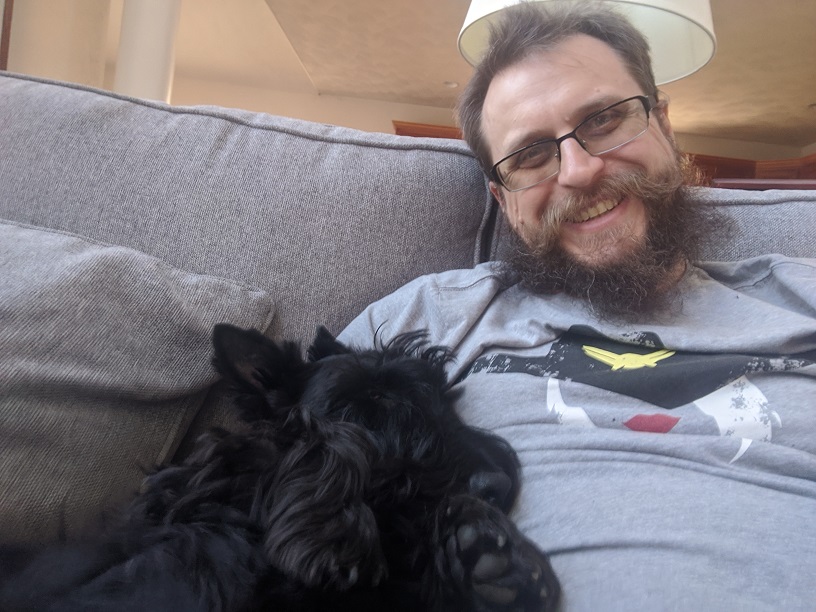
As a bonus for reading this far, here’s a photo of me and my friend Dougal:

Selfie of the author and a Scottish terrier

Dougal understands that he might need to be separated from the mini-humans for safety’s sake but wants you to remember that puppies need attention too.

If you’re a Satanist here looking for advise on how to build your own holiday ritual, here are some of the resources I found helpful:

  • Anton LaVey, The Satanic Bible. Whether you find yourself leaning towards The Church of Satan or The Satanic Temple, this feels like required reading. It’s important to understand the role this work played relative to the “Satanic Panic” of the 80s. Decide for yourself which ideas to keep and which to destroy.
  • bell hooks, All About Love. In order to look at LaVey objectively, I found myself routinely comparing him with hooks. They present dramatically different perspectives on life but share a common philosophy of self-love.
  • Shiva Honey, The Devil’s Tome. This was a convenient resource for designing my own rituals. Having a basic framework in place for the holiday allowed me to focus on how to make it work for me.
  • Ernestine Hayes, The Tao of Raven. In my quest to celebrate the sun, it would be remiss of me not to mention the inspiration I found in Raven. Here I learned how I could be devious and practical at the same time.
  • Shannon Lee, Be Water, My Friend. It’s impossible to understand Fire without also understanding its relation to Water. Lee provides many practical examples of using self-affirmations to reach one’s objectives.
  • Pull from whatever sources you enjoy! My holidays would up being influenced by Donnie Darko, Wandavision and Final Fantasy. The benefit to having your own symbols is that you get to decide what they mean.

Ave Sol Invictus! And Happy Holidays to all!

I didn’t become a teacher with the intention of doing it forever.  My original goal was to design educational video games, but I felt it would be presumptuous of me to build such technology without ever having set foot in a classroom.  Becoming a math teacher seemed like the fastest way for me to find out what kinds of tools schools actually needed. Now I’m not even sure I’m the same person.  

I made countless mistakes during the twelve years I spent teaching, but the one thing I think I got right was approaching it with a “here-to-learn attitude”.  Learning can only take place with the learner’s consent.  Opening one’s self up to learning a new skill means allowing oneself to be vulnerable to mistakes.  Teaching is about creating an environment where multiple learners feel comfortable with the risks of engaging in that process together. The first step is to establish a relationship of trust.

In all honesty, relationship building has never been one of my strengths so I had to make an active effort to improve on it as a teacher.  I found that the most powerful method for facilitating a student’s learning is to simply ask what they need and listen to what they say.  Really listen and trust them.  It’s incredibly difficult to learn when you’re tired, hungry, or stressed. Sometimes “taking a break” is a necessary stage in the learning process. Treating people with kindness is a prerequisite for any meaningful learning to take place.   

One of the most difficult challenges for me as a teacher was learning how to navigate spaces of trauma.  For me, mathematics is something that evokes feelings of joy but my experiences are both highly abnormal and shaped by privilege.  More often a student’s experiences with mathematics are shaped by structural forms of oppression including racism, sexism, and ableism.  Learning how to openly reflect on how I was complicit in these systems was a key factor in my growth as a teacher.  I believe students should be able to see themselves in mathematics, so I tried to actively seek out and integrate the stories of mathematicians from diverse backgrounds into the curriculum.  The self-work continues to be an ongoing process.

My goal as a teacher was to construct an environment where my students could freely “play” with mathematics.  I feel learners are entitled to the opportunity of exploring mathematics and discovering new knowledge on their own.  Often the play comes with a set of constraints that help direct it towards a specific objective, but the important qualities are that the task has a low skill floor and high skill ceiling.  There should be both an easy way for everyone to engage and the depth to encourage further exploration.  Too often we fall into a trap of erroneously thinking there’s “one right answer” in mathematics, so I make it a point to include questions with “no wrong answer”.  I found this helped to foster a culture of collaboration in the classroom because everyone’s input is of equal value in the discussion.

Exploration has limited effectiveness when you’re obligated to address very specific learning objectives, so I usually follow up with some form of direct instruction to fill in the gaps. It’s not quite as engaging, but sometimes students need a concrete example of the behavior they’re expected to model. Our brains are very efficient at mirroring actions.  I’ve found that “worked examples” can also provide a valuable resource afterwards when the student is attempting to replicate the process on their own.  As the number of examples grows, the metacognitive process of learning how to organize this information can reveal insights into its structure.

The next phase of the learning process is to engage in a cycle of formative assessment and feedback known as “practice”.  Any new skill must be practiced to be maintained.  This is one area where I think educational technology excels, because it can enable nearly instantaneous feedback to learners.  While my students often enjoyed the “gamification” of practice, it’s important to select such products carefully.  I’ve learned it’s important for developers to remember that “accuracy is more important than speed” and “some skills cannot be assessed through multiple-choice”.  As our technology improves, so will our automated feedback.  I’m particularly excited about the potential applications of “Large Language Models” in this area, but the application of Artificial Intelligence will also require a great deal of testing before it meets the ethical criteria necessary for use in the classroom.

In the reality of schooling, there’s likely to be a summative assessment stage in the learning process as well, but I tend to think this distinction is artificial.  As far as my class policies were concerned, all assessments are treated as formative where possible.  I tried to allow my students the opportunity to retake assessments as often as needed to the extent I was able. This is another aspect of teaching I found heavily supported by technology.  The combination of algorithmic question generation with automated feedback made it possible for me to focus on the broader picture provided by the data over time.  

If anything, I tend to look at summative assessment data as a tool for self-reflection.  As a student, summative assessments provide me with a form of external validation that I have in fact learned what I set out to learn.  As a teacher, the relation between assessment data and my own performance was always a little bit fuzzy but the process of looking back at that data and asking questions about what I could do differently was an essential part of my personal self-improvement.  I think it’s important to not put too much stock in any one assessment and instead use multiple data sources like observations and interviews to help triangulate areas for growth.  

The final stage in the learning process is to teach what you have learned to someone else.  I think we sometimes overlook this stage because it starts a new cycle of learning, but there are subtle differences between having a skill and being able to teach that skill to others.  Through attempting to teach math, I often found myself seeing old concepts in a new light.  My knowledge of geometry and data analysis grew deeper each time a student asked me “why?”.   Sometimes the most powerful phrase in the classroom is “I don’t know. How can we find out?”.  Likewise, I’m thankful that I had co-workers that were more knowledgeable about teaching than myself and capable of sharing that expertise.  I’m hopeful that I’ll be able to use what I’ve learned about teaching to help others as well.

I’m not necessarily looking for another “teaching job” but the act of teaching has become inseparable from how I learn.   Even if no one reads what I write, the act of putting my thoughts into words has power in it.  No matter where I go or what I do, I will learn new things and attempt to teach them to others.  We face a critical moment in society where we need to recognize the true value of the skills that teachers can bring to an organization. Every organization must learn to grow and teachers are experts on learning how to learn.